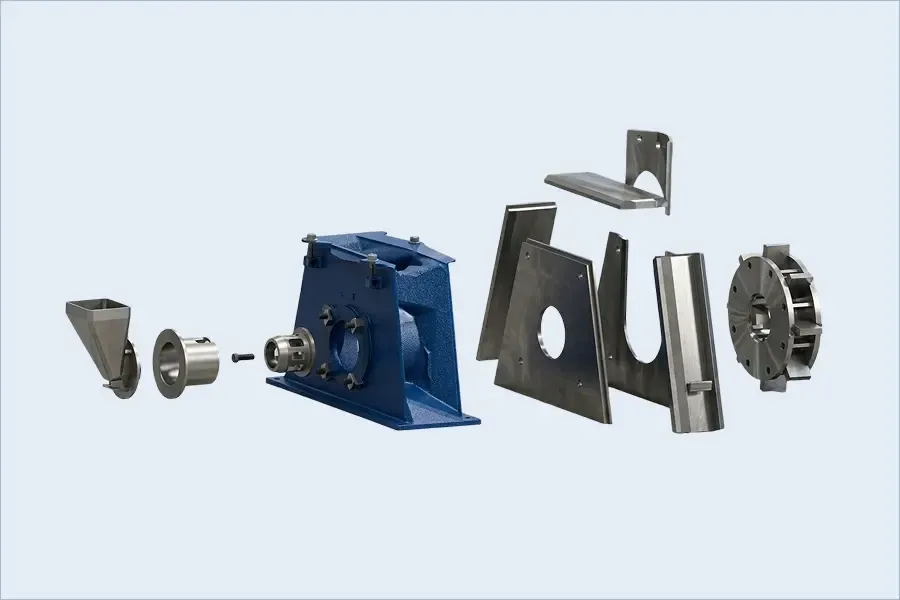
Blast Wheel Shot Blasting Turbine

Blast Wheel Shot Blasting Turbine

The Blast Wheel (Shot Blasting Turbine) is the core working component of every airless shot blasting machine. It converts electrical energy into kinetic energy to accelerate abrasive media such as steel shot, steel grit, garnet, or cut wire shots, projecting them onto the workpiece surface at high velocity.

Designed for high efficiency, durability, and uniform abrasive distribution, the blast wheel is responsible for achieving effective cleaning, peening, deburring, and surface roughening. A properly engineered shot blasting turbine ensures maximum blasting performance with minimum abrasive consumption, making it one of the most critical parts of any industrial shot blasting system.

We design and supply optimized blast wheel systems with precise positioning and abrasive selection to achieve maximum productivity and uniform surface finish.

Smart Process Overview

Working Principle

Abrasive media enters the control cage through the feed spout and is guided toward the impeller. The impeller provides the initial acceleration and directs the abrasive toward the rotating blades. The blades then accelerate the abrasive to high velocity before it exits the wheel in a controlled blast pattern.

When the abrasive strikes the component surface, it removes rust, mill scale, old coatings, burrs, or contaminants, depending on the application. Accurate control of throwing direction and wheel speed ensures efficient surface preparation with consistent cleaning quality.

Optimized Wheel Variants

Types of Blast Wheels

  • Direct Drive Blast Wheel

    The motor is directly coupled with the rotor, resulting in higher efficiency with no transmission loss. This design offers compact construction and lower maintenance requirements.

  • Belt Drive Blast Wheel

    Uses a pulley and V-belt arrangement between the motor and rotor. It provides flexible mounting options and easier servicing.

  • High-Efficiency Curved Blade Wheel

    Advanced blade geometry improves abrasive acceleration and blasting efficiency while reducing abrasive consumption.

  • Double-Sided / Reversible Blade Wheel

    Blade design allows both sides to be used, extending blade life and reducing downtime for replacement.

Blast Wheel Shot Blasting Turbine

Built With Precision Components

Main Components

1

Impeller

Provides the initial acceleration of abrasive media before transfer to the blades.

2

Control Cage

Controls abrasive throwing direction and blast pattern.

3

Blades (Vanes)

Provide final acceleration of abrasive media to high speed.

4

Rotor / Wheel Hub

Supports and secures the blades during operation.

5

Distributor

Feeds abrasive evenly into the wheel assembly.

6

Housing with Liners

Protective casing fitted with wear-resistant liners for longer service life.

Engineered Output Parameters

Standard Technical Specifications

Motor Power 3 HP to 50 HP
Wheel Diameter 300 mm to 650 mm
RPM Range 1500 – 3000 RPM
Shot Flow Rate 30 – 1200 kg/min
Blade Tip Speed 60 – 80 m/s
Abrasive Size 0.2 – 2.0 mm
Efficiency 70 – 85%

Capacity Chart (HP vs Shot Flow)

Motor HP 3 HP 5 HP 7.5 HP 10 HP 15 HP 20 HP 25 HP 30 HP 40 HP 50 HP
Wheel Dia. 250–300 mm 300 mm 300–350 mm 350 mm 380–400 mm 400–450 mm 450 mm 450–500 mm 500–550 mm 550–600 mm
Typical RPM 2800–3000 2800–3000 2800–3000 2800–3000 2800–3000 2800–3000 2800–3000 2800–3000 2200–2800 2200–2500
Shot Flow 40–70 kg/min 70–100 kg/min 100–150 kg/min 140–180 kg/min 180–250 kg/min 250–320 kg/min 320–400 kg/min 400–500 kg/min 500–650 kg/min 650–850 kg/min
Abrasive Velocity 55–65 m/s 60–70 m/s 65–75 m/s 70–75 m/s 70–80 m/s 75–85 m/s 75–90 m/s 80–95 m/s 85–100 m/s 90–110 m/s
Cleaning Capacity Approx 8–15 sqm/hr 15–25 sqm/hr 25–40 sqm/hr 35–55 sqm/hr 50–80 sqm/hr 70–110 sqm/hr 90–140 sqm/hr 120–180 sqm/hr 160–250 sqm/hr 220–350 sqm/hr

Custom Engineered Mechanism

Abrasive Compatibility

The blast wheel is compatible with a wide range of metallic and non-metallic blasting media, depending on the required finish and application. Commonly used abrasives include steel shot ranging from S110 to S780 for cleaning and peening, steel grit from G25 to G80 for aggressive surface roughening, garnet in fine to coarse grades for controlled blasting, and cut wire shots for precision finishing applications. This flexibility makes the shot blasting turbine suitable for varied industrial processes requiring different blasting intensities and surface profiles

Related Industries You May Like

Explore a wide range of industries where shot blasting plays a critical role in improving surface quality, durability, and production efficiency. From automotive and foundry to fabrication and heavy engineering, Jinil's solutions are designed to meet diverse application needs, ensuring reliable surface preparation, consistent finishing, and optimized performance across demanding industrial environments.

Complete Support Portfolio

Applications

The shot blasting turbine is used in multiple industrial blasting processes.

1

Surface cleaning for rust and scale removal

2

Shot peening for fatigue improvement

3

Surface roughening before coating

4

Deburring and finishing operations

5

High-speed industrial surface preparation

Operational Performance Benefits

Advantages

The blast wheel system provides several operational and performance benefits.

  • High blasting efficiency
  • Uniform abrasive distribution
  • Low power consumption
  • Long component service life
  • Easy maintenance and part replacement
  • Optimized blast pattern
  • Reliable continuous operation

Advanced Engineering Highlights

Design Features

The shot blasting turbine is engineered for durability, efficiency, and smooth operation.

  • Optimized blade angle for maximum energy transfer
  • Balanced rotor for vibration-free running
  • Quick-change blade system
  • Compact and robust housing
  • Durable wear-resistant internal components

Decision Making Factors

Selection Guidelines

  • Required blasting capacity in kg/min or m²/hr
  • Type of machine, such as tumbler, hanger, tunnel, or table
  • Abrasive media type and particle size
  • Component geometry and surface area
  • Desired production rate and throughput
  • Wheel positioning for maximum coverage
  • Maintenance preference and operating efficiency

Additional System Enhancements

Optional Features

The system can be upgraded with additional features based on machine requirements.

  • Wear-resistant alloy blades (Cr-Mo / high chrome)
  • Adjustable control cage for pattern tuning
  • Auto shot flow control valve
  • VFD-compatible motor
  • Heavy-duty liners (Mn steel/rubber)
  • Dynamic balancing for vibration-free operation

Frequently Asked Questions

Clear answers to common questions about Jinil's shot blasting machines, surface preparation solutions, and engineering support—helping you make informed decisions with confidence.
1. What is a blast wheel in a shot blasting machine? +

A blast wheel is the main rotating component of an airless shot blasting machine that accelerates abrasive media at high speed for cleaning and surface preparation.

2. What is the function of a shot blasting turbine? +

The shot blasting turbine converts motor power into kinetic energy to propel abrasive media onto metal surfaces for cleaning, roughening, or finishing.

3. Which abrasives can be used with a blast wheel? +

Common abrasives include steel shot, steel grit, garnet, and cut wire shot, depending on blasting requirements.

4. What industries use blast wheels? +

Blast wheels are widely used in automotive, foundry, fabrication, railways, oil & gas, aerospace, and heavy engineering industries.

5. What is the difference between direct drive and belt drive blast wheels? +

Direct drive wheels offer higher efficiency and compact design, while belt drive systems provide flexible mounting and easier maintenance.

6. How do reversible blades help? +

Reversible blades extend service life by allowing both sides of the blade to be used before replacement.

7. Can a blast wheel be customized? +

Yes, options such as alloy blades, adjustable cages, VFD motors, liners, and balancing upgrades can be supplied.

8. Why is blast wheel design important? +

Proper blast wheel design improves abrasive acceleration, reduces media loss, enhances cleaning quality, and increases machine productivity.